
Pricing
Applicable roles: Organization (top-level user), Sub-user Last updated: 2026-07-09
This document explains in the simplest possible way: how the platform charges, how much a single call costs, and how to check prices.
1. The Simplest Version: Explained in Three Sentences
The platform's billing logic can be summed up in one sentence: Top up → Call → Deduct based on actual usage.
- No monthly fee, no minimum spend—you pay only for what you use.
- The money you top up converts 1:1 into "credits" (1 CNY = 1 credit), and credits are deducted based on usage when you call a model.
- Every model has a base price. Different groups (service tiers) apply a discount or markup on top of the base price, and it's up to you which tier to choose.
2. What Are Credits
Credits are the platform's unified billing unit, and their relationship to CNY is very simple:
1 CNY = 1 credit, always, with no exchange rate fluctuations.
If you top up 100 CNY in the console, your account has 100 credits. Each model call deducts the corresponding credits, and your remaining credits are your available balance.
To check your current balance: log in to the console, and you can see your organization balance on the dashboard homepage.
Note: "Credits" and "balance" are essentially the same thing, just referred to differently in different contexts. When topping up it's called "balance," and when deducting it's called "credits"—the values are identical.
3. How Many Credits Does a Single Model Call Cost
Basic Formula
The cost of each model call is determined by two factors: how many Tokens are used and the model's unit price under the group you selected.
Calculation formula:
Cost of this call (credits) = Input cost + Output cost

Input cost = Input Token count / 1,000,000 x the group's input unit price
Output cost = Output Token count / 1,000,000 x the group's output unit price
Input and output are priced separately—the text you send to the model is calculated at the "input price," and the text the model replies with is calculated at the "output price." Output is usually more expensive than input.
Model Base Price and Group Discounts
Every model has a base price (standard price), which is the standard credit unit price defined by the platform. Different groups apply a discount on top of the base price:
Group unit price = Base price x DiscountThe discount is the ratio of the markdown or markup:
- Discount 0.6 = 40% off (60% of the base price, the cheapest)
- Discount 1.0 = original price (same as the base price)
- Discount 2.0 = double price (includes more stable service guarantees)
You don't need to calculate these yourself—the price shown in the Model Marketplace and the Call Guide is the final unit price for the group you selected, so just look at that number directly.
Whether it's an overseas model or a domestic model, they all use the same discount mechanism. The only difference is the base price.
Practical Calculation Examples
Example 1: Writing a piece of code with Claude Sonnet
Suppose you send a programming question with 800 input Tokens, and the model replies with 1,200 Tokens.
Under the group you selected, Claude Sonnet's unit price is: 3 credits/million Tokens for input, 15 credits/million Tokens for output.
Input cost = 800 / 1,000,000 x 3 = 0.0024 credits
Output cost = 1,200 / 1,000,000 x 15 = 0.018 credits

Total cost = 0.0024 + 0.018 = 0.0204 credits ≈ 2 cents
A simple programming Q&A costs only about 2 cents.
Example 2: 10 rounds of conversation with GPT-4o
Suppose you chat with GPT-4o for 10 rounds, with a cumulative input of about 15,000 Tokens (including context) and an output of about 5,000 Tokens.
Under the group you selected, GPT-4o's unit price is: 2.5 credits/million Tokens for input, 10 credits/million Tokens for output.
Input cost = 15,000 / 1,000,000 x 2.5 = 0.0375 credits
Output cost = 5,000 / 1,000,000 x 10 = 0.05 credits

Total cost = 0.0375 + 0.05 = 0.0875 credits ≈ less than 9 cents
10 rounds of conversation total less than 1 jiao.
Example 3: Saving money with caching (supported by Claude and other models)
Some models support "prompt caching"—if you repeatedly send the same system prompt or long context, the model automatically caches this portion of content. Once the cache is hit, these Tokens are not billed at the regular input price, but at the cheaper cache read price.
Take Claude Sonnet as an example. Suppose you're doing code review, and each call carries the same 5,000-Token project specification as the system prompt, plus a 500-Token actual question, with the model replying 1,000 Tokens.
First call (cache miss, requires writing to the cache; the write price is slightly higher than the regular input price):
Cache write cost = 5,000 / 1,000,000 x 3.75 = 0.01875 credits
Regular input cost = 500 / 1,000,000 x 3 = 0.0015 credits
Output cost      = 1,000 / 1,000,000 x 15 = 0.015 credits

First total cost = 0.03525 credits ≈ 3.5 cents
Subsequent calls (cache hit; the cache read price is only one-tenth of the regular input price):
Cache read cost = 5,000 / 1,000,000 x 0.3 = 0.0015 credits
Regular input cost = 500 / 1,000,000 x 3 = 0.0015 credits
Output cost      = 1,000 / 1,000,000 x 15 = 0.015 credits

Cost per subsequent call = 0.018 credits ≈ less than 2 cents
Compared to not using caching (full input of 5,500 Tokens):
Without caching = 5,500 / 1,000,000 x 3 + 1,000 / 1,000,000 x 15 = 0.0315 credits ≈ 3.2 cents/callWith caching, each subsequent call drops from 3.2 cents to less than 2 cents, saving nearly 40%. The more calls you make, the more cost-effective it is.
The above unit prices are for illustration only; actual prices are subject to what's shown in the Model Marketplace. Whether caching is available depends on whether the model itself supports it and on the calling method—see the Developer Guide for details.
4. What Are Groups
A group can be understood as a "service tier." For the same model, the platform provides services through different groups, and each group differs in price and stability.
As an analogy: it's like taking a high-speed train with second-class and first-class seats—the destination is the same, but the comfort and price differ.
| Group Type | Characteristics | Who It Suits |
|---|---|---|
| Economy (lower discount) | Lowest price, may occasionally fluctuate | Personal learning, test development, scenarios with low stability requirements |
| Standard (discount around 1.0) | Moderate price, good stability | Everyday business use |
| Premium (higher discount) | Higher price, most stable channel | Production environments, businesses with strict availability requirements |
Notes:
- Group names and specific prices are subject to what's actually shown in the console's "Model Marketplace" or "Call Guide." The table above is for illustration only.
- When creating an API key, you select and bind a group, and all subsequent calls made with that key are billed at that group's price.
- Which group to choose depends entirely on your needs: choose Economy for low cost, choose Premium for stability.
- Both overseas and domestic models use the same group discount mechanism.
5. Where to Check the Latest Prices
| What You Want to Know | Where to Look |
|---|---|
| A model's credit unit price under each group | Console → Model Marketplace, find the corresponding model, and view the listed prices for each group |
| Currently available models and groups | Console → Call Guide, which lists all available models by group |
| Top up and purchase credits | Console → Redeem |
| Billing details of past calls | Console → Usage Records, where you can view the Token consumption and amount deducted for each call |
| Current balance | Console → Dashboard homepage |
Model prices may change due to supplier price adjustments or platform policy changes. Please refer to what's actually shown in the console.
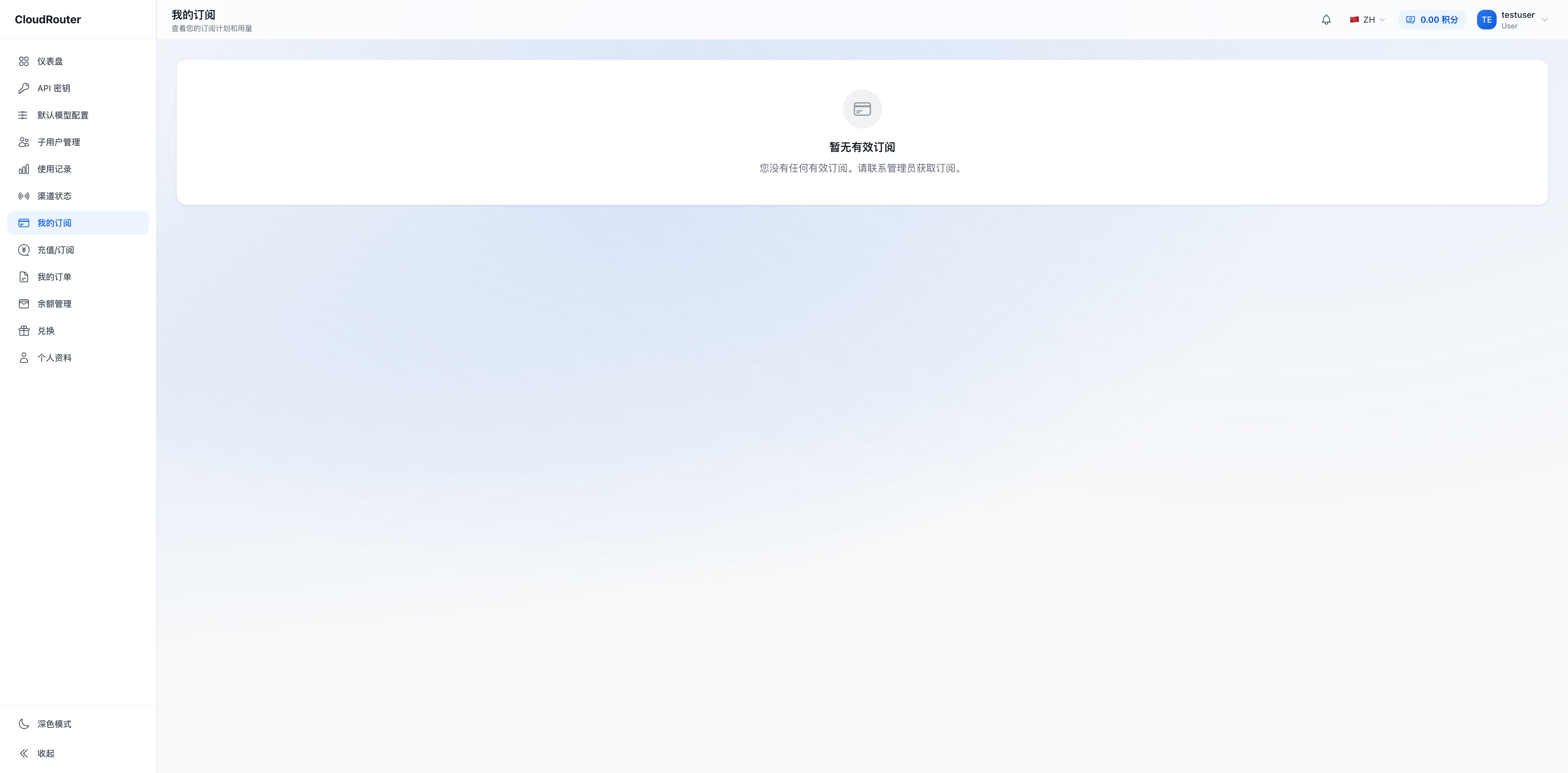
My Subscription page:
6. FAQ
Q: Roughly how long can 100 CNY last?
A: It depends on which model you use and how much. Taking Claude Sonnet (Standard group) as an example, a rough estimate:
- One regular conversation (about 800 input + 1,200 output Tokens) ≈ 0.02 credits
- 100 credits can support roughly 5,000 such simple conversations
For long document processing or large amounts of code generation, Token consumption increases significantly, and the actual number of calls decreases accordingly. Overall, for light everyday use, 100 CNY can last a long time.
Q: What's the difference between credits and balance?
A: There's no difference—they're different names for the same thing. What's shown when topping up is the "balance," and what's deducted during billing is "credits." 1 credit = 1 CNY, and the values are exactly the same.
Q: What is a Token?
A: A Token is the basic unit AI models use to process text. You can roughly understand it as: 1 Chinese character is approximately equal to 1 to 2 Tokens, and 1 English word is approximately equal to 1 Token. For example, the four characters "你好世界" are roughly 4 to 8 Tokens. You don't need to count Tokens yourself—the platform automatically calculates them and displays them in your usage records.
Q: Is there a free quota after registration?
A: Whether free credits are granted upon new registration depends on the current promotional activities. If you use a promo code or redemption code during registration, the corresponding credits will be added directly to your account. Please refer to the prompts on the registration page for specifics.
Q: Why does the same model have different prices in different groups?
A: Because the service channels behind different groups differ. Groups with higher discounts typically use more stable, higher-quality channels with better service guarantees, so they're more expensive. Groups with lower discounts have lower costs but may be slightly less stable. You can choose the appropriate group based on your business scenario.
Q: What is caching? How much can it save?
A: Some models (such as the Claude series) support prompt caching. If your calls contain large repeated sections of context (such as a fixed system prompt), the model automatically caches this portion. Once the cache is hit, these Tokens are billed at a price far lower than the regular input price—typically only about one-tenth of the regular input price. The more repeated calls, the more cost-effective.
Q: What is the discount?
A: The discount is the markdown or markup ratio each group applies to the model's base price. For example, if the base price is 3 credits/million Tokens, a discount of 0.6 means you actually only pay 1.8 credits/million Tokens in this group. The lower the discount, the cheaper. You don't need to remember these numbers—the price shown in the Model Marketplace is already the final price after conversion.
Q: Can I get a refund after topping up?
A: If you need a refund, please contact the platform's customer service team to work out a resolution.